Professional Motor Mechanic—March 2004
Oscilloscopes are an indispensable piece of diagnostics kit. PMM's product tester, Peter Xerri tried out the PC based ADC 212/3 model from Pico Technology.
I've run my own business for the last 24 years and have seen a lot of changes in that time. However, in the last four or five years the rate of change has speeded up. The vehicle systems are becoming more complex and as independents we don't receive technical bulletins from the vehicle manufacturers to keep us up to date, nor do we benefit from their training programs. A car's electronic control systems has undergone the most rapid change and we have to understand these systems to deal with the problems that come with them.
Whatever the fault on a car; whether it's mechanical or electrical your diagnosis has to be accurate and as fast as possible, and you also have to be confident in that diagnosis. With mechanical faults it's often possible to both see and feel the problem; for example excess travel on the brake pedal and loss of braking efficiency might be traced to a leaking wheel cylinder. Replace the cylinder, bleed the brakes and the job is done. If only the electronic problems were as simple!
The ADC 212/3 [Replaced by 4425A] is very affordable, it doesn't require annual software updates or harnesses for different models
It's possible to access fault codes stored by the ECU but some faults will not produce a code, and some codes could have been registered as a result of somebody else trying to locate the problem perhaps by disconnecting components in a trial and error fashion. If you suspect not all the codes read are 'true' you can of course make a note then clear them and run the car (if possible) to re-register any codes. But as with the leaking wheel cylinder it's good to 'see' the faulty component; an oscilloscope allows you to do just that.
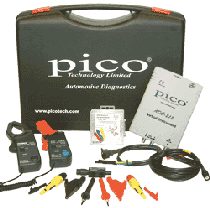
The Pico ADC 212/3 [Replaced by 4425A] comes as a complete kit with a substantial list of leads, clips, pick-ups and current clamps and connects to your PC (not included) turning it into an automotive scope. I used a laptop which is far less cumbersome than a desk top system for around the workshop. It's very easy to set up and connect. Opening the automotive menu and selecting the sensor or circuit you want to test, the PicoScope provides a guide to which leads and connections you will need, and where to attach them.
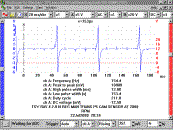
Incorporating a library of waveforms it will also provide an example of a good waveform for comparison with the one produced by the suspect sensor or circuit. It also gives useful technical information to help solve the problem.
I must admit to being a bit of a novice when it comes to scopes, I used to own a couple of old tuning scopes but these became obsolete, but the PicoScope has opened up a new door for me. I felt very comfortable using it, trying out a variety of faults from a couple of non-starters, an alternator fault and a fast idle problem with good results. The instructions on connecting and setting up the scope are clear and concise, and the library of example waveforms is a great help when first using the scope and are always there for reference even as you become more experienced. It gives live data which you know is accurate and so is a great method of fault finding.
The ADC 212/3 [Replaced by 4425A] is very affordable, it doesn't require annual software updates or harnesses for different models, and can be used on both diesel and petrol vehicle. Was I impressed? Very much so.
Verdict: Great diagnostic tool, accurate, user-friendly and affordable.
|