


|
|
|||
 |
|||
| Log In | |||
|
|||
|
|||
|
| |||
|
|||
| |||
|
|||
|
| |||
|
|||
| |||
|
|||
| |||


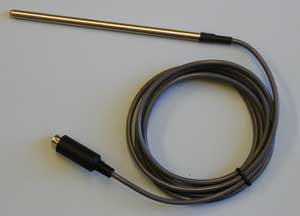
Platinum resistance thermometers (PRTs) offer excellent accuracy over a wide temperature range (from -200 to 850 C). Sensors are interchangeable between different manufacturers, and are available in various accuracy ratings in packages to suit most applications. Unlike thermocouples, it is not necessary to use special cables to connect to the sensor. The principle of operation is to measure the resistance of a platinum element. The most common type (PT100) has a resistance of 100 ohms at 0 C and 138.4 ohms at 100 C. There are also PT1000 sensors that have a resistance of 25 ohms and 1000 ohms respectively at 0 C. The relationship between temperature and resistance is approximately linear over a small temperature range: for example, if you assume that it is linear over the 0 to 100 C range, the error at 50C is 0.4 C. For precision measurement, it is necessary to linearise the resistance to give an accurate temperature. The most recent definition of the relationship between resistance and temperature is International Temperature Standard 90 (ITS-90). Rt = R0 * (1 A* t B*t2 C*(t-100)* t3) A = 3.9083 E-3 For a PT100 sensor, a 1 C temperature change will cause a 0.384ohm change in resistance, so even a small error in measurement of the resistance (for example, the resistance of the wires leading to the sensor) can cause a large error in the measurement of the temperature. For precision work, sensors have four wires- two to carry the sense current, and two to measure the voltage across the sensor element. It is also possible to obtain three-wire sensors, although these operate on the (not necessarily valid) assumption that the resistance of each of the three wires is the same. The current through the sensor will cause some heating: for example, a sense current of 1mA through a 100 ohm resistor will generate 100uW of heat. If the sensor element is unable to dissipate this heat, it will report an artificially high temperature. This effect can be reduced by either using a large sensor element, or by making sure that it is in good thermal contact with its environment. Using a 1mA sense current will give a signal of only 100mV. Because the change in resistance for a degree celsius is very small, even a small error in the measurement of the voltage across the sensor will produce a large error in the temperature measurement. For example, a 100uV voltage measurement error will give a 0.4 C error in the temperature reading. Similarly, a 1uA error in the sense current will give 0.4 C temperature error. Because of the low signal levels, it is important to keep any cables away from electric cables, motors, switchgear and other devices that may emit electrical noise. Using screened cable, with the screen grounded at one end, may help to reduce interference. When using long cables, it is necessary to check that the measuring equipment is capable of handling the resistance of the cables. Most equipment can cope with up to 100 ohms per core. The type of probe and cable should be chosen carefully to suit the application. The main issues are the temperature range and exposure to fluids (corrosive or conductive) or metals. Clearly, normal solder junctions on cables should not be used at temperatures above about 170 C. Sensor manufacturers offer a wide range of sensors that comply with BS1904 class B (DIN 43760): these sensors offer an accuracy of ±0.3 C at 0 C. For increased accuracy, BS1904 class A (±0.15 C) or tenth-DIN sensors (±0.03 C). Companies like Isotech can provide standards with 0.001 C accuracy. Please note that these accuracy specifications relate to the SENSOR ONLY: it is necessary to add on any error in the measuring system as well. Related standards are IEC751 and JISC1604-1989. IEC751 also defines the colour coding for PRT sensor cables: the one or two wires attached to one end of the sensor are red, and the one or two wires at the other end are white.
Pico Products for use with PT100 sensorsThe Pico Technology PT-104 is a complete data logging solution for recording temperature using PT100 and PT1000 sensors offering the ultimate in accuracy (0.01 °C) and resolution (0.001 °C) . We also have a range of PT100 sensors suitable for use with the PT104. The Pico Technology CM004 signal conditioner works with 4-wire PT100 sensors and offers ±0.2 °C accuracy. It can be used either with a Pico ADC16 converter, or with the EnviroMon data logging system. |
||||||

 This linearisation is done automatically, in software, when using Pico signal conditioners. The linearisation equation is
  |
 |
|||
|
|
|
 |